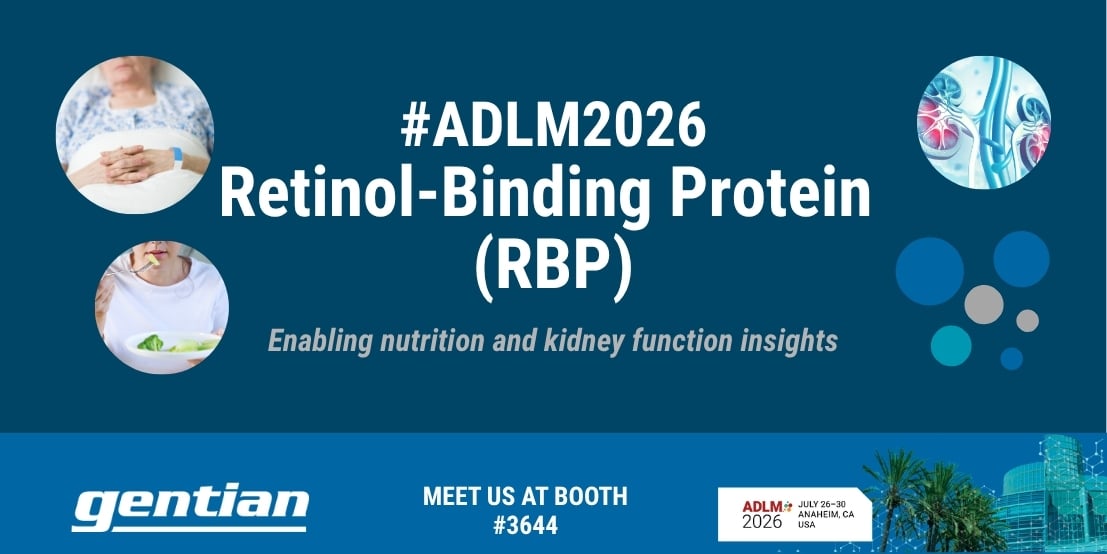
RBP testing: A practical addition for nutrition and renal assessment
Are you looking to expand your laboratory’s testing capabilities? Gentian’s Retinol-Binding Protein (RBP) Immunoassay offers a quantitative measurement of RBP on routine chemistry analysers, supporting diagnostic insights across vitamin A status, nutrition, renal health, and diabetes.
Meet us at booth #3644 at ADLM 2026 or schedule a meeting at
marketing@gentian.com to learn more.
Why labs are adding RBP now
RBP is particularly relevant in nutritional screening, monitoring of kidney tubular function, and metabolic disease evaluation:
-
Growing focus on nutritional assessment
-
Increased metabolic disease burden
-
Need for rapid, scalable biomarkers
.png?width=800&height=250&name=CTA(8).png)
Why RBP matters: A multi-purpose biomarker
Retinol-Binding Protein (RBP) is a key transport protein for vitamin A (retinol) in the bloodstream. Synthesized in the liver, RBP binds to retinol before entering circulation. After retinol delivery, RBP is filtered by the kidneys and nearly fully reabsorbed by the proximal renal tubule.1,2
RBP levels are relatively stable in healthy individuals, but fluctuations may signal underlying health conditions, including:
- Vitamin A deficiency
- Undernutrition
- Diabetes
- Renal dysfunction

Gentian Retinol-Binding Protein Immunoassay
Gentian’s turbidimetric RBP assay is designed for automated, high-throughput clinical chemistry analysers, enabling seamless integration into routine workflows.
Whether for routine testing or research applications, Gentian’s assay fits seamlessly into diverse laboratory workflows:
- Instrument independent
- FDA Exempt
- CE-marked, UKCA-marked
The assay boasts high precision with a coefficient of variation (CV) below 5% and a limit of quantification (LoQ) at 7.81 mg/L. The measuring range extends from 7.8 to 139 mg/L, making it suitable for various clinical needs.
Visit us at ADLM 2026 to:
- See how to implement RBP in routine workflows
- Review performance data and reference ranges
- Explore how RBP can expand your assay menu
Interested in implementing RBP testing in your lab?
Fill out the form or contact us directly at marketing@gentian.com to request more information, pricing, or technical documentation.
References:
- Steinhoff JS et al. Nutrients. 2022;14(6)
- Tanumihardjo SA et al. J Nutr. 2016;146(9):1816s-48s
This website may contain information about products that are not registered for use in your country of residence and may not comply with applicable laws or regulations in that country. We do not take any responsibility for accessing such information in those circumstances.
.png)
.png)